

TheFlightDispatcher.com
Air Operations & Dispatch Insights
Written by an aviation operations professional with 20+ years of experience.

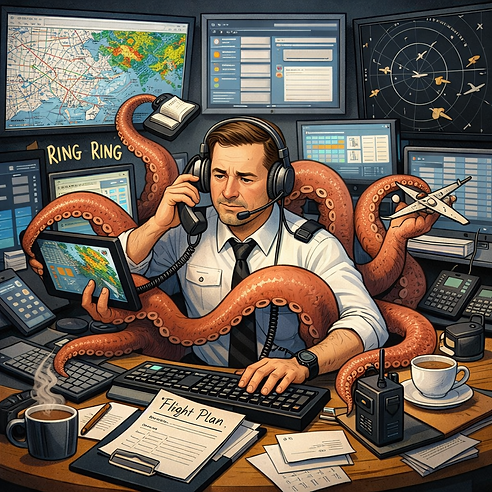
Multi Functionalism in Aircraft Operations: Myth, Reality, or Unreal Expectations?
In modern aviation, “multi functionalism” is often praised as a hallmark of efficiency and professionalism. Pilots, dispatchers, and operational staff are expected to seamlessly juggle multiple responsibilities, adapt instantly to changing conditions, and maintain flawless performance. But beneath this expectation lies a fundamental question: is true multitasking even possible—or are we simply pushing human cognition beyond its natural limits?
The Illusion of Multitasking
What is commonly referred to as multitasking is, in reality, task switching. The human brain does not process multiple complex tasks simultaneously; instead, it rapidly alternates attention between them. Some individuals are better at this than others, able to jump from one task to another and back again while retaining most of the relevant information. However, even for these individuals, there is a cost.
Modern aviation systems are becoming increasingly complex. As complexity rises, the time required to process each task decreases, forcing operators into more frequent and rapid task-switching cycles. The “leaps” between tasks become shorter, more frequent, and more cognitively demanding. The critical question becomes: how long can this acceleration continue before performance begins to degrade?
Automation: Simplifier and Complicator
Automation, artificial intelligence, and advanced software have undeniably transformed aviation operations. Tasks that were once manual, repetitive, and physically demanding are now streamlined and automated. This has reduced workload in certain areas and improved precision.
However, this simplification comes at a cost.
Automation shifts the human role from doing to monitoring and deciding. Operators are now expected to:
-
Interpret complex data streams,
-
Validate automated outputs,
-
Make rapid decisions based on system-generated analyses.
In essence, while machines perform the physical work, humans are left managing the cognitive complexity. Instead of needing “eight arms like an octopus,” modern operators often feel they need eight brains—each capable of handling a different analytical thread simultaneously.
Communication Overload
Compounding this challenge is the explosion of communication channels. A typical aviation professional today may be handling:
-
Emails,
-
Instant messages (e.g., WhatsApp, both individual and group),
-
Phone calls,
-
VOIP calls across multiple platforms.
Each communication demands attention, context switching, and often immediate response. The result is a constant fragmentation of focus. Unlike machines, the human mind does not parallel-process these inputs efficiently. It processes them sequentially, which leads to overload, missed information, and increased error probability.
Linear Minds in a Non-Linear Environment
Human cognitive processes are inherently linear. We perform best when tasks follow a structured sequence—one step leading logically to the next.
Aviation, however, is increasingly non-linear. Especially outside of tightly defined procedures, tasks emerge simultaneously, priorities shift dynamically, and interruptions are constant. This mismatch between human cognition and operational reality creates a fertile ground for errors.
The Dispatcher’s Reality
Nowhere is this more evident than in small business aviation environments, where roles often overlap. Consider a flight dispatcher who is not only responsible for operational planning but also:
-
Administrative duties,
-
Key Account Management,
-
Direct communication with clients or their representatives.
In such environments, everything is treated as urgent. Priorities are rarely clear, interruptions are constant, and expectations are high. A dispatcher may begin a task, be interrupted multiple times, and then return to it—only to question whether it was completed correctly.
How many times does such a dispatcher redo work?
How much cognitive energy is spent not on doing the task, but on verifying whether it was done correctly?
This is not inefficiency—it is the inevitable consequence of sustained task switching under pressure.
Conclusion
Multi functionalism in aviation is not a myth—but the expectations surrounding it often are. While humans can adapt to complex environments, there are limits imposed by cognitive architecture. Ignoring these limits does not increase efficiency; it increases risk.
Recognizing the distinction between capability and capacity is essential. The industry must ask not just what humans can do, but what they can do reliably, consistently, and safely.
Here is an extract from a public article found on NASA’s website
'Most flight phases of air carrier and commuter operations employ well-designed standard procedures that are linear in nature - a given required task follows another required task. For example, in the takeoff phase, the application of power is followed by a check of engine performance or power, which in turn may be followed by a performance check at 80 knots, and V1, VR, V2, gear, and flap retraction respectively, depending on the particular aircraft and operator.
In contrast, duties in the pre-flight phase may be non-linear, i.e., there may be no logical or prescribed sequence. A pilot may need to deal with flight planning, weather information, changes, fuel loading, dispatch manifests and release, last-minute maintenance or MEL items, duty time requirements, or aircraft deicing at the same time. There may be no standard operating procedure (SOP) for assigning sequence or priority to these tasks, nor does one task necessarily require that another task be previously and correctly completed - thus, it may be easier to make an undetected error.'
A bit further the article also contains the solution, which I will also publish integrally:
'Recommendations:
It is suggested that companies and flight personnel consider providing greater structure to pre-flight activities in order to reduce the frequency of time-related errors. Similarly, when distraction and schedule pressure occur in this flight phase, a reasonable response is to slow down and carry out tasks in a practical, linear fashion. Where time-related pressure is encountered from external sources, pilots may find it a good strategy to calmly explain the nature, probability, and typical results of hurry-up errors to those who "apply the pressure."
Maintain an awareness of the potential for the Hurry-Up Syndrome in pre-flight and taxi-out operational phases.
When pressures to "hurry-up" occur, particularly in the pre-flight operational phase, it is a useful strategy for pilots to take the time to prioritize their tasks.
If a procedure is interrupted for any reason, returning to the beginning of that task and starting again will significantly reduce the opportunity for error.
Now imagine a normal day for a flight dispatcher working for a small business aviation company where additional tasks for dispatchers are the norm. Administrative tasks, Key Account Manager tasks, being in touch directly with clients or client representatives, people who in general treat absolutely everything as a priority. How many times does such a flight dispatcher redo work?